Blog

How Vacuum Impregnation Helps Reduce Warranty Claims & Strengthen Customer Confidence

In modern manufacturing, warranty exposure has become one of the most dangerous silent profit killers. While product quality is often measured on production lines, the true test of reliability happens in the field — months or years after delivery. When pressure-handling components begin to leak under real-world operating conditions, the consequences extend far beyond simple […]

How Vacuum Impregnation Helps Reduce Warranty Claims & Strengthen Customer Confidence Read More »

Choosing the Right Sealant: Methacrylate vs Epoxy vs Anaerobic — What Engineers Must Know

In modern manufacturing, sealing is no longer a secondary process — it is a critical engineering decision that directly affects product safety, performance, and lifecycle cost. Whether in automotive, electric vehicle, aerospace, hydraulics, or compressor systems, internal porosity sealing must deliver permanent, pressure-tight reliability under extreme thermal, chemical, and mechanical stress. Yet many plants continue

Choosing the Right Sealant: Methacrylate vs Epoxy vs Anaerobic — What Engineers Must Know Read More »

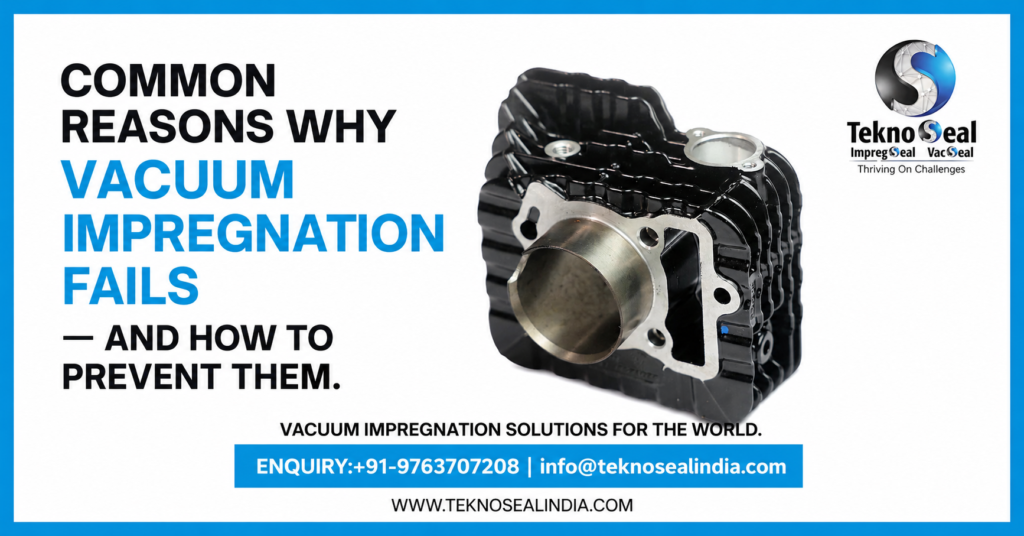
Common Reasons Why Vacuum Impregnation Fails — and How to Prevent Them

Understanding where impregnation fails — and how to prevent those failures — is essential for eliminating scrap, reducing rework loops, and protecting OEM confidence. Why Impregnation Fails in Real Production Environments Impregnation is a precision-controlled chemical-mechanical process. Every stage — from pretreatment to curing — must work in harmony. When even one parameter drifts, the

Common Reasons Why Vacuum Impregnation Fails — and How to Prevent Them Read More »

How Vacuum Impregnation Eliminates Porosity and Reduces Manufacturing Scrap

Introduction: The Hidden Cost of Porosity in Manufacturing In modern manufacturing, achieving precision and reliability is no longer optional—it is essential. Industries such as automotive, aerospace, hydraulics, and electronics depend heavily on cast components that must perform under pressure, temperature, and long operational cycles. However, one persistent challenge continues to impact production efficiency: porosity. Porosity

How Vacuum Impregnation Eliminates Porosity and Reduces Manufacturing Scrap Read More »

Industries That Depend on Vacuum Impregnation Technology

Should All Castings Be Impregnated? Understanding When to Seal and When to Scrap Vacuum impregnation is one of the most effective technologies available for permanently sealing internal porosity in cast and machined components. It has rescued millions of high-value parts from rejection and stabilized quality across global manufacturing supply chains. However, impregnation is not a

Industries That Depend on Vacuum Impregnation Technology Read More »

Vacuum Impregnation Sealants Explained: How They Work Inside Micro Pores

How Vacuum Impregnation Ensures Reliability in EV Components The global transition toward electric mobility has fundamentally reshaped automotive engineering. In pursuit of extended driving range, faster thermal response, and improved energy efficiency, manufacturers are replacing traditional ferrous castings with lightweight aluminium and magnesium alloys. While this transformation delivers performance advantages, it also introduces a critical

Vacuum Impregnation Sealants Explained: How They Work Inside Micro Pores Read More »

How Vacuum Impregnation Machines Improve Production Efficiency

Polymer Breakdown at High Temperature – Why Sealant Selection Matters Modern automotive and EV engineering operates at temperatures that were once unimaginable. Turbochargers glow red-hot, EV thermal management systems cycle through rapid heating and cooling, brake assemblies endure intense friction heat, and compressor systems operate continuously under pressure. In such extreme environments, internal porosity sealing

How Vacuum Impregnation Machines Improve Production Efficiency Read More »

Vacuum Impregnation vs Welding vs Resin Coating: Which Method Works Best?

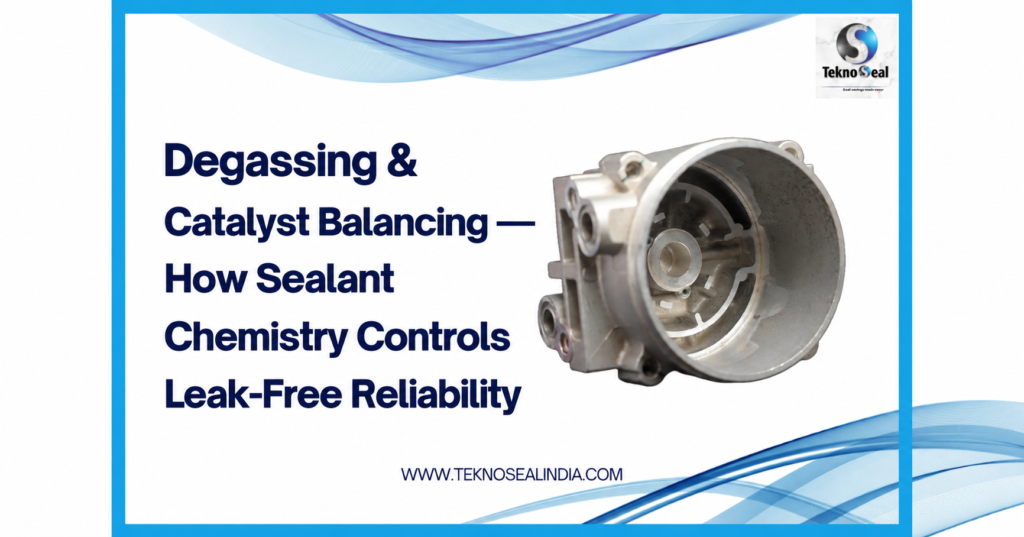
Sealant Degassing & Temperature Control – The Heart of Impregnation Success Vacuum impregnation is often perceived as a mechanical process defined by chambers, pumps, pressure cycles, and curing ovens. In reality, impregnation success is driven as much by chemistry as by machinery. Across hundreds of manufacturing audits worldwide, a consistent pattern has emerged: most impregnation

Vacuum Impregnation vs Welding vs Resin Coating: Which Method Works Best? Read More »

What Causes Porosity in Castings? A Complete Engineering Guide

Why Leading Automotive OEMs Trust Teknoseal for Critical Porosity Sealing In today’s fiercely competitive global automotive industry, component suppliers are evaluated on far more than price and delivery schedules. Reliability, consistency, long-term field performance, and zero-defect manufacturing have become the real benchmarks of supplier qualification. Automotive OEMs demand absolute confidence that every pressure-bearing component will

What Causes Porosity in Castings? A Complete Engineering Guide Read More »

Why Pretreatment Determines the Success of Vacuum Impregnation

Vacuum impregnation is one of the most reliable engineering solutions for permanently sealing internal porosity in cast and machined components. Yet across foundries and machining plants worldwide, many impregnation failures have nothing to do with sealant chemistry, machine capability, or operator skill. The real cause almost always lies upstream — in pretreatment. Pretreatment is the

Why Pretreatment Determines the Success of Vacuum Impregnation Read More »

Translate »