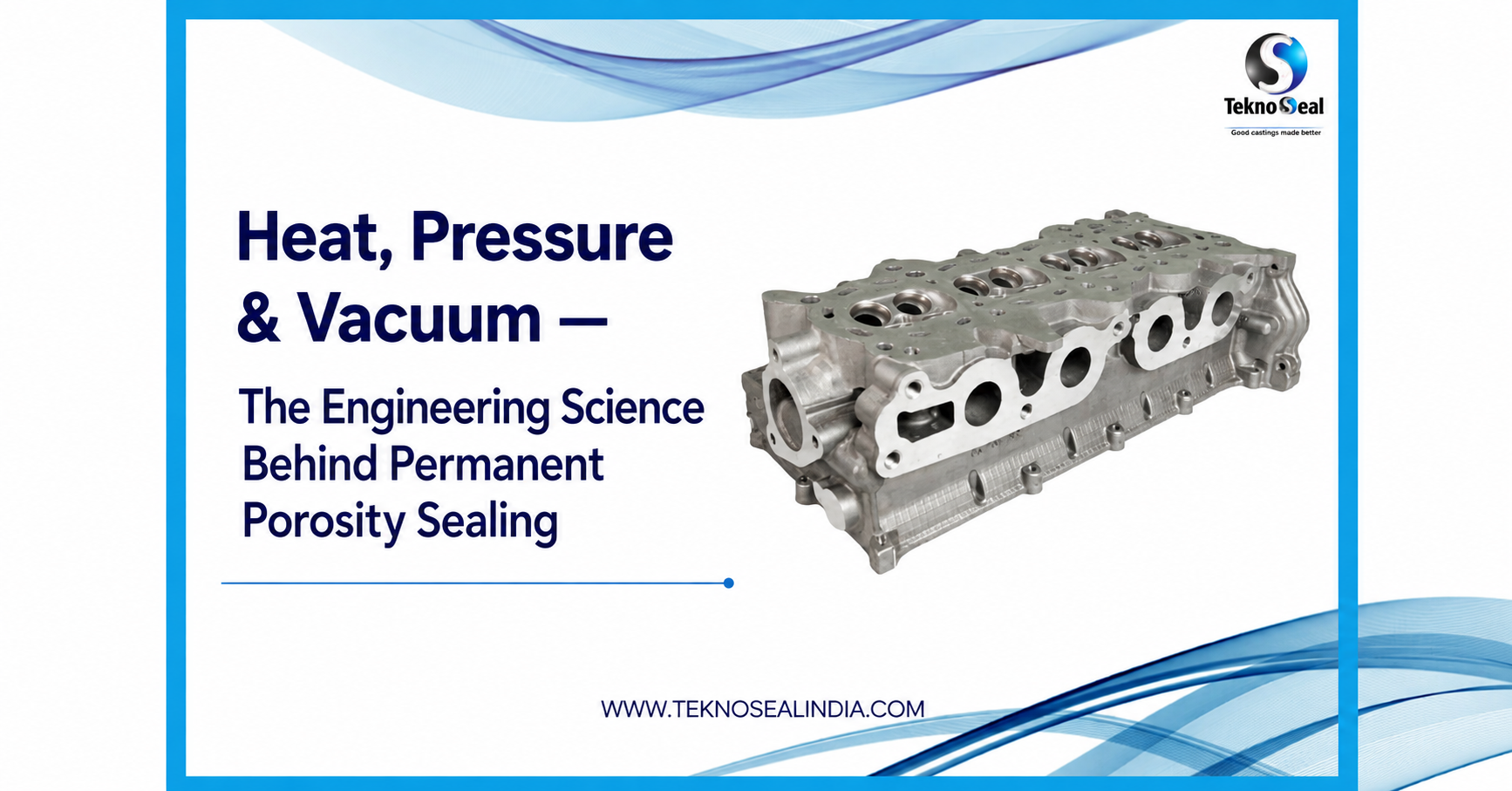
Porosity is an unavoidable reality in metal casting — but leakage is not. In modern automotive, EV, aerospace, hydraulic and precision engineering, the true challenge is not eliminating porosity, but controlling it in a way that ensures absolute functional integrity. This is where vacuum impregnation emerges as one of the most scientifically reliable sealing technologies used globally. At its core, vacuum impregnation is not a “process” — it is an engineered interaction of vacuum physics, pressure dynamics, and polymer chemistry working together to permanently seal microscopic internal leak paths.
Understanding this science allows manufacturers to transform unpredictable scrap losses into stable, leak-free production systems.
The Physics Behind Porosity Sealing
Every casting — whether aluminium, magnesium, iron or brass — contains microscopic voids formed during metal solidification. These voids may remain isolated, or they may connect internally to form invisible capillary leak paths. Even when invisible, such networks allow air, oil, fuel, coolant, refrigerants or hydraulic fluids to escape once the component is pressurized.
Vacuum impregnation seals these internal networks by manipulating pressure differentials inside the material itself.
| Variable | Engineering Role |
| Vacuum | Removes trapped gases from pores |
| Pressure | Drives sealant deep into capillary paths |
| Polymerization | Converts liquid sealant into solid polymer |
| Thermal activation | Strengthens molecular bonding |
Without vacuum, sealant cannot enter pores. Without pressure, it cannot fully occupy them. Without proper polymerization, the seal becomes temporary and weak. Only when all four variables work together does permanent internal sealing occur.
Step One: Vacuum — Creating Internal Access
The first stage of impregnation applies a deep vacuum inside a sealed chamber. This vacuum extracts trapped air and gases from microscopic pore networks inside the casting. These trapped gases act as internal “blockers” — preventing sealant from entering leak paths if not removed.
By evacuating this internal atmosphere, the component’s pore structure becomes receptive to sealant infiltration. This stage determines penetration quality — poor vacuum equals poor sealing, regardless of how good the sealant may be.
Step Two: Pressure — Driving the Sealant In
Once the vacuum stage prepares the pores, low-viscosity methacrylate sealant such as TSP99 is introduced while the chamber remains under vacuum. Pressure is then applied to force the liquid sealant deep into interconnected porosity networks
This pressure stage ensures:
- Complete filling of micro-capillary paths
- Sealing of blind internal pores
- Elimination of continuous leak channels
- Uniform penetration regardless of part geometry
Unlike surface coatings or manual repair methods, impregnation seals from the inside — preserving surface finish, machining accuracy, and dimensional tolerances.
Step Three: Polymerization — Converting Chemistry into Strength
Penetration alone is not enough. The sealant must be converted into a mechanically stable polymer inside the pore network.
During controlled heating, the methacrylate sealant polymerizes into a thermoset plastic — forming solid molecular plugs inside the casting structure. This internal polymer:
- Withstands vibration and pulsating pressure
- Remains stable under high temperature cycles
- Resists oils, coolants, fuels and refrigerants
- Does not shrink, soften or degrade over time
The result is a permanent internal seal — not a surface patch.
Real Industrial Example
A Tier-1 supplier machining aluminium compressor heads for HVAC and automotive OEMs faced repeated pressure failures above 65 bar. Despite passing initial inspection, machined parts failed leak testing and were being scrapped at 10% rates — causing heavy financial losses.
A process audit revealed inconsistent vacuum depth and curing temperature drift during impregnation cycles.
After implementing:
- Correct vacuum depth discipline
- Stable pressure hold duration
- Controlled thermal curing cycles
Leak performance improved dramatically:
| Metric | Before | After |
| Leak pressure endurance | 65 bar | 120 bar |
| Scrap rate | 10% | 0.8% |
| Customer acceptance | Unstable | Fully approved |
The supplier not only recovered profitability but also secured long-term OEM contracts.
Why Engineering Discipline Matters
Vacuum impregnation is not a trial-and-error activity. It is a controlled scientific system. When any of its parameters drift — vacuum, pressure, temperature or polymerization — results immediately become inconsistent.
Plants that apply impregnation scientifically experience:
- Predictable pass rates
- Elimination of rework loops
- Stable OEM audit performance
- Stronger supplier credibility
- Lower warranty exposure
Conclusion
Porosity is a natural characteristic of cast metal. Leakage is a failure of process discipline.
Vacuum impregnation represents the merging of physics and polymer chemistry into a single controlled system — converting invisible defects into permanent internal strength. When engineered correctly, it becomes one of the most powerful tools for achieving zero-leak manufacturing reliability in modern high-performance components.