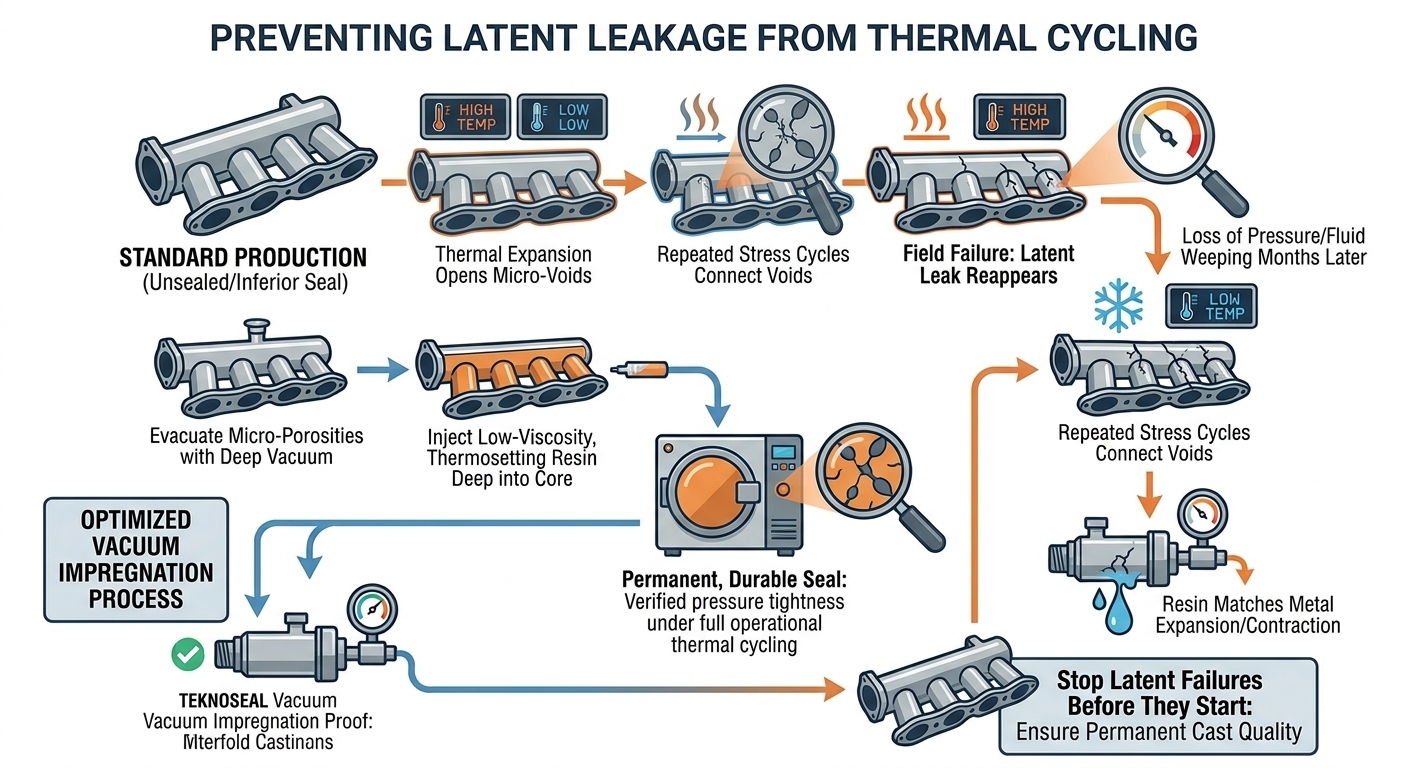
In modern automotive, EV, aerospace and hydraulic systems, components do not fail suddenly — they fail gradually. One of the most dangerous reliability threats facing manufacturers today is delayed leakage caused by thermal cycling fatigue inside porous castings. Components often pass factory pressure tests, only to begin leaking months later in field operation. These failures are expensive, reputation-damaging, and difficult to diagnose — because the root cause lies deep inside microscopic pore networks.
Understanding thermal cycling fatigue is critical to eliminating delayed warranty failures.
What Is Thermal Cycling Fatigue?
Thermal cycling refers to repeated heating and cooling cycles that components undergo during normal operation. For example:
| Application | Typical Thermal Cycles |
| Turbo housings | 30°C → 220°C |
| EV motor housings | 25°C → 140°C |
| Hydraulic blocks | 20°C → 120°C |
| Aerospace components | –50°C → 180°C |
Each cycle causes microscopic expansion and contraction inside the metal structure. Over thousands of cycles, this movement progressively stresses internal porosity networks.
Why Micro-Porosity Becomes Leak Paths
Inside porous castings, interconnected pores form capillary networks. Thermal cycling causes:
- Micro-expansion of pore walls
- Molecular fatigue in untreated pores
- Progressive widening of capillary channels
- Breakdown of weak sealant patches
Eventually, microscopic leak paths reopen — allowing fluid or gas to escape even though the part originally passed pressure testing.
This is why leaks often reappear after 6–18 months of field operation.
Why Surface Repairs Always Fail
Surface coatings, epoxy patches, and weld rework address visible defects — not internal porosity networks. Under thermal cycling:
- Surface sealants shrink
- Adhesive bonds fatigue
- Patch zones crack microscopically
But internal pores remain untreated — making delayed leakage inevitable.
How Vacuum Impregnation Prevents Porosity Fatigue
Vacuum impregnation permanently seals internal pore networks by filling micro-capillary channels with thermally stable methacrylate polymer. Once polymerized, this internal polymer:
- Expands and contracts with metal
- Resists shrinkage and fatigue
- Remains chemically inert
- Maintains pressure integrity
This transforms porous metal into internally reinforced composite structures.
Industry Case
A heavy-equipment OEM faced rising warranty claims from hydraulic valve bodies leaking after 8–12 months of service. Despite passing factory tests, field failures escalated rapidly.
After implementing vacuum impregnation:
| Metric | Before | After |
| Field leakage | 2.4% | <0.1% |
| Warranty cost | ₹3.8 Cr | ₹0.2 Cr |
| OEM audit status | At risk | Preferred |
Why Delayed Failures Are So Expensive
Delayed failures multiply costs:
- Dealer service labour
- Logistics & part replacement
- Customer downtime compensation
- Brand reputation damage
- Risk of recall
Prevention is exponentially cheaper than recovery.
Conclusion
Thermal cycling does not create porosity — it exposes untreated porosity. Vacuum impregnation eliminates this hidden fatigue mechanism permanently.
Leak-free reliability must survive not only pressure — but time.