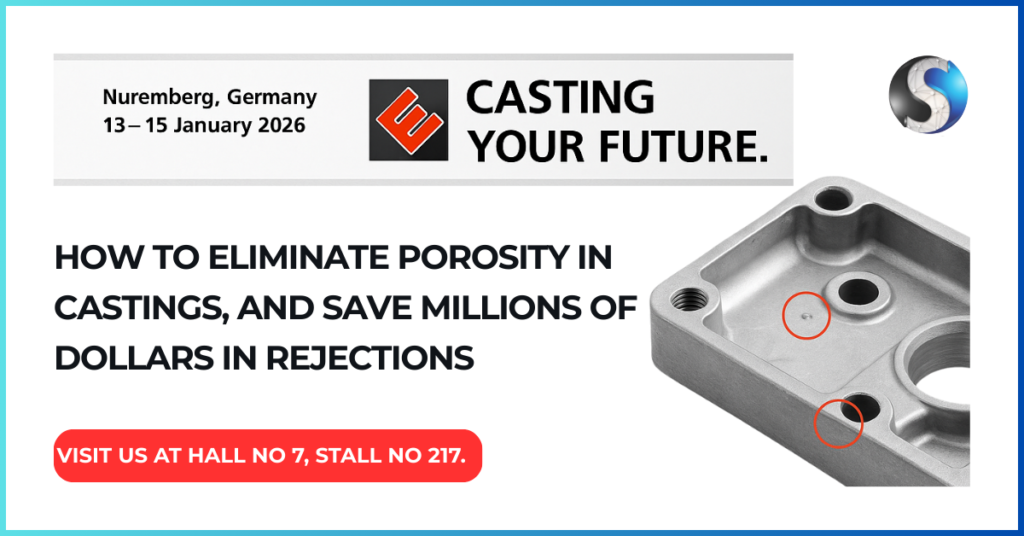
Porosity remains one of the most urgent, costly challenges in the die-casting and metal casting industries. Whether it is aluminium metal casting, brass components, iron parts or complex magnesium housings, microscopic voids inside castings can lead to large-scale rejections, leak failures, machining losses, customer complaints and expensive warranty claims. In an era where OEMs demand uncompromising reliability, tight leak-rate thresholds and extended product life, the need to solve porosity permanently has never been greater.
Across major industrial clusters, manufacturers preparing for Euroguss 2026, the world’s most influential Trade Fair for Die Casting, are re-evaluating their processes to eliminate porosity at source and ensure stability of supply to global customers. What was once seen as an acceptable casting flaw is today considered a costly manufacturing defect. The shift toward zero-defect manufacturing has accelerated investments in the impregnation process, especially among companies dealing with fluid- or pressure-holding components.
Why Porosity is Such a Large-Scale Cost Burner
Porosity is not merely air trapped during the moulding stage. As castings move through machining, shot blasting, electroplating, powder coating, pressure testing and final inspection, porosity manifests in leakage failures, surface finish defects, low mechanical strength and dimensional deformation.
The biggest concern arises during leak testing.
A casting that appears perfect externally may fail during:
- Hydraulic pressure tests
- Helium leak tests
- Air-under-water testing
- Vacuum decay tests
For manufacturers dealing in automotive components, engine housings, gear casings, e-mobility drive systems, hydraulic manifolds, brake systems and refrigeration parts, rejections cause massive losses—often running into millions of dollars annually.
Typical porosity-related losses include:
- Scrapping finished machined parts
- Loss of machining cost
- Increased production cycles
- Labour and time wasted on reprocessing
- Lost billing due to customer rejections
- Diminished confidence and poor supplier ratings
For exporters, these failures also translate into loss of business, cancellation of supply contracts and difficulty qualifying for future RFQs.
Where Traditional Repair Techniques Fail
Manufacturers have historically attempted temporary alternatives including:
- Weld repairs
- Epoxy patches
- Seal-by-heat curing compounds
- Surface sealing lacquers
However, none of these solutions guarantee sealing of the internal porosity network. Coatings sit on the surface, while epoxy-based fixes degrade under high temperature or chemical exposure, and repairs often fail during field usage.
In metal casting industries dealing with precision tolerances, these approaches are neither sustainable nor recommended by global quality frameworks.
Vacuum Impregnation: Transforming Defective Castings Into Saleable Components
Modern vacuum impregnation is designed precisely to handle internal porosity. Unlike surface coatings, impregnation penetrates deep within the microscopic voids using vacuum and controlled pressure cycles. This ensures that every interconnected pore is filled with a polymer sealant.
The result is:
✔ Zero leakage
✔ Permanent pore sealing
✔ Better mechanical strength
✔ Improved pressure performance
✔ Higher machining yield
✔ Greater acceptability during audits
Vacuum impregnation has therefore emerged as the global benchmark to salvage porosity-affected castings without altering dimensions, metallurgy or surface finish.
Industries using impregnation include:
- Automotive & EV
- Industrial hydraulics
- Aerospace
- Marine systems
- Agricultural equipment
- Power transmission
- Refrigeration & HVAC
The process aligns with statistically acceptable rejection limits and plays a major role in sustainability—because instead of scrapping parts, manufacturers convert rejects into approved deliverable goods.
Why Euroguss 2026 Matters for Manufacturers
The upcoming Euroguss 2026 exhibition has a dedicated spotlight on next-generation casting technologies, smart manufacturing and defect-free metal casting. Companies operating in the die-casting domain—whether as OEMs, Tier-1 suppliers or component exporters—will experience a global showcase of innovations.
Topics expected to be discussed include:
- New die-casting alloys
- AI-based predictive casting simulations
- Cost-saving methods in machining
- Lightweight aluminium metal casting for EVs
- Surface finishing technologies
- Improvements in sealing reliability via impregnation
For companies already facing porosity challenges, this platform is ideal to understand new-age impregnation machinery, global sealant standards, automation-ready systems and sustainability-led manufacturing workflows.
Teknoseal – Vacuum Impregnation Solutions for the World
Teknoseal is a globally proven vacuum impregnation company offering advanced sealants and fully engineered impregnation plants for the world’s leading foundries, machining units and OEMs. The brand specialises in sealing porosity in castings made of aluminium, iron, brass, magnesium and several other metals. Teknoseal pioneered vacuum impregnation equipment design in India and built one of the world’s finest ranges of casting sealants—tested and approved across global automotive and engineering norms.
Its products comply with US MIL Specifications, Lloyd’s Register standards and UL approvals. Teknoseal sealants and machines are export-ready and accepted by major OEMs in more than 15 countries, making it one of the few world-class sealant manufacturers in India with validated global credentials. Backed by an American Patent and verified vendor registration with US Federal Contractor Systems, Teknoseal continues to set quality benchmarks in the impregnation process.
To understand how your organisation can prevent losses, recover rejected castings and unlock profitability through world-class vacuum impregnation solutions, connect with Teknoseal at ENQUIRY: +91-9763707208 | info@teknosealindia.com