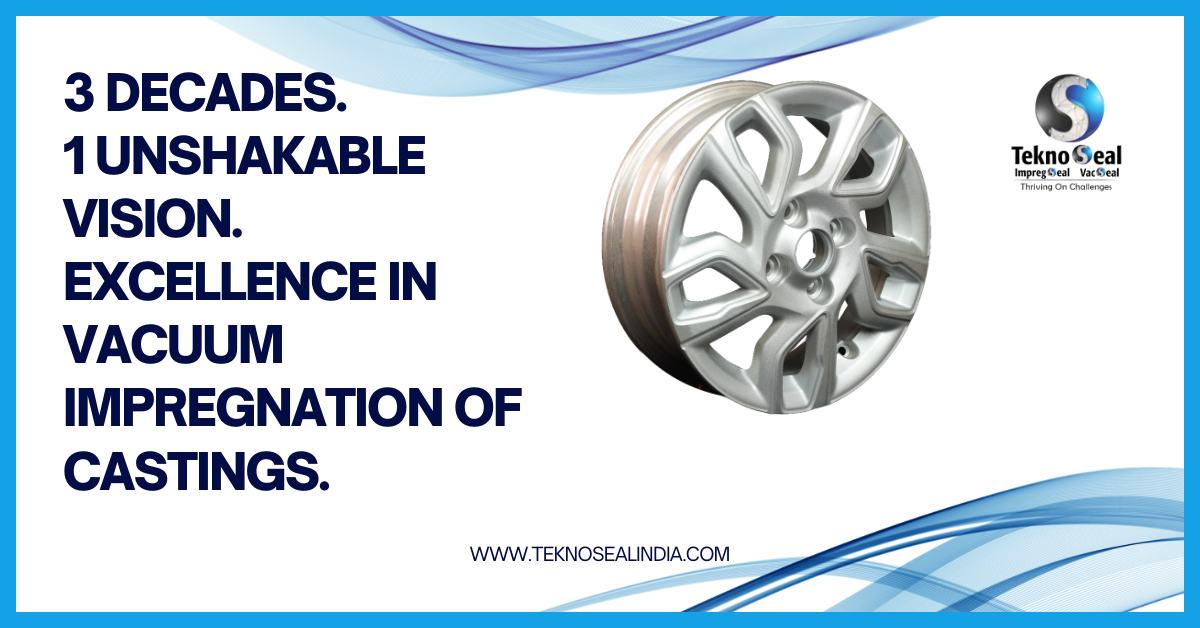
How Vacuum Impregnation Ensures Reliability in EV Components
The global transition toward electric mobility has fundamentally reshaped automotive engineering. In pursuit of extended driving range, faster thermal response, and improved energy efficiency, manufacturers are replacing traditional ferrous castings with lightweight aluminium and magnesium alloys. While this transformation delivers performance advantages, it also introduces a critical reliability challenge: increased internal porosity.
Thin-wall aluminium castings, now common in EV platforms, are inherently more porous due to rapid cooling rates, complex internal channels, and reduced wall thickness. In conventional vehicles, minor porosity might be tolerated. In electric vehicles, however, even microscopic leak paths become functional risks — capable of triggering overheating, electrical faults, corrosion, and catastrophic system failures.
Vacuum impregnation has therefore evolved from a corrective process into a foundational reliability technology for EV manufacturing.
Why Porosity Sealing Is Mission-Critical in EV Systems
EV architectures operate under uniquely demanding conditions. Battery thermal management systems, motor housings, inverter enclosures, gearbox casings, coolant circuits, and compressor bodies must function continuously under high pressure, extreme thermal cycling, and persistent vibration.
Key EV components that require absolute leak integrity include:
- Battery enclosures
- Motor housings
- Inverter and controller casings
- Gearbox housings
- Coolant system components
- Pump and compressor bodies
Even micro-porosity as small as a few hundred microns can allow coolant, dielectric fluids, refrigerants, or pressure-regulated gases to escape. This can lead to:
- Overheating of battery packs
- Electrical short circuits
- Reduced insulation resistance
- Corrosion of internal electronics
- Sudden loss of pressure integrity
In EV applications, a single leak path can compromise safety, vehicle performance, and OEM reputation.
How Vacuum Impregnation Creates Permanent Internal Sealing
Vacuum impregnation using advanced methacrylate sealants such as TSP 99 permanently seals interconnected micro-porosity networks inside the metal structure. Unlike surface coatings, patch repairs, or external sealants, impregnation works internally — precisely where the leak originates.
During impregnation, components are placed in a sealed chamber and subjected to vacuum to remove trapped gases. A low-viscosity sealant is then introduced and driven deep into porosity networks under pressure. Controlled heat curing polymerizes the sealant into a permanent thermoset polymer that blocks all leak channels without altering dimensional tolerances, surface finish, or material properties.
The result is a pressure-tight, chemically resistant component capable of surviving long-term EV operating conditions.
Real Industry Case
A leading EV manufacturer was experiencing repeated leak failures in thin-wall aluminium motor housings during 100–120 bar pressure testing. Rework attempts including surface sealing, welding, and machining modifications failed to deliver stable results, as the root cause remained internal porosity.
A customized vacuum impregnation cycle optimized for internal channel geometry and critical sealing zones was implemented. The transformation was immediate:
- Rejection dropped to 1.2%
- Huge leap in annual scrap recovery
- Export contracts were protected
- Field failure risk was eliminated
The OEM subsequently included impregnation as a mandatory process in its global supplier quality manuals.
Benefits of Vacuum Impregnation for EV Systems
| EV Requirement | Impregnation Advantage |
| High-pressure sealing | Eliminates micro-leak paths |
| Thermal shock resistance | Polymer stability under rapid temperature changes |
| Chemical compatibility | Resists coolants, oils, dielectric fluids |
| Thin-wall castings | Seals porosity without distortion |
| Warranty reliability | Prevents long-term leak return risk |
Why EV Manufacturing Depends on Impregnation
EV systems integrate high-voltage electronics, thermal control loops, and pressure-bearing structures in compact architectures. The combination of electricity, coolant, and vibration makes leak-proof performance essential not just for durability — but for safety certification and global homologation.
Vacuum impregnation ensures:
- Long-term thermal stability
- Chemical inertness
- Permanent internal sealing
- Consistent pressure integrity
- Reduced warranty exposure
These benefits directly influence OEM audit results, field reliability ratings, and brand perception.
Conclusion
As EV platforms become more compact, lighter, and thermally demanding, internal porosity becomes an increasingly critical reliability risk. Vacuum impregnation is no longer a post-production repair — it is a core engineering enabler that ensures safe, efficient, and durable electric vehicle performance.
Reliability in EV manufacturing is engineered from within — and impregnation makes that possible.