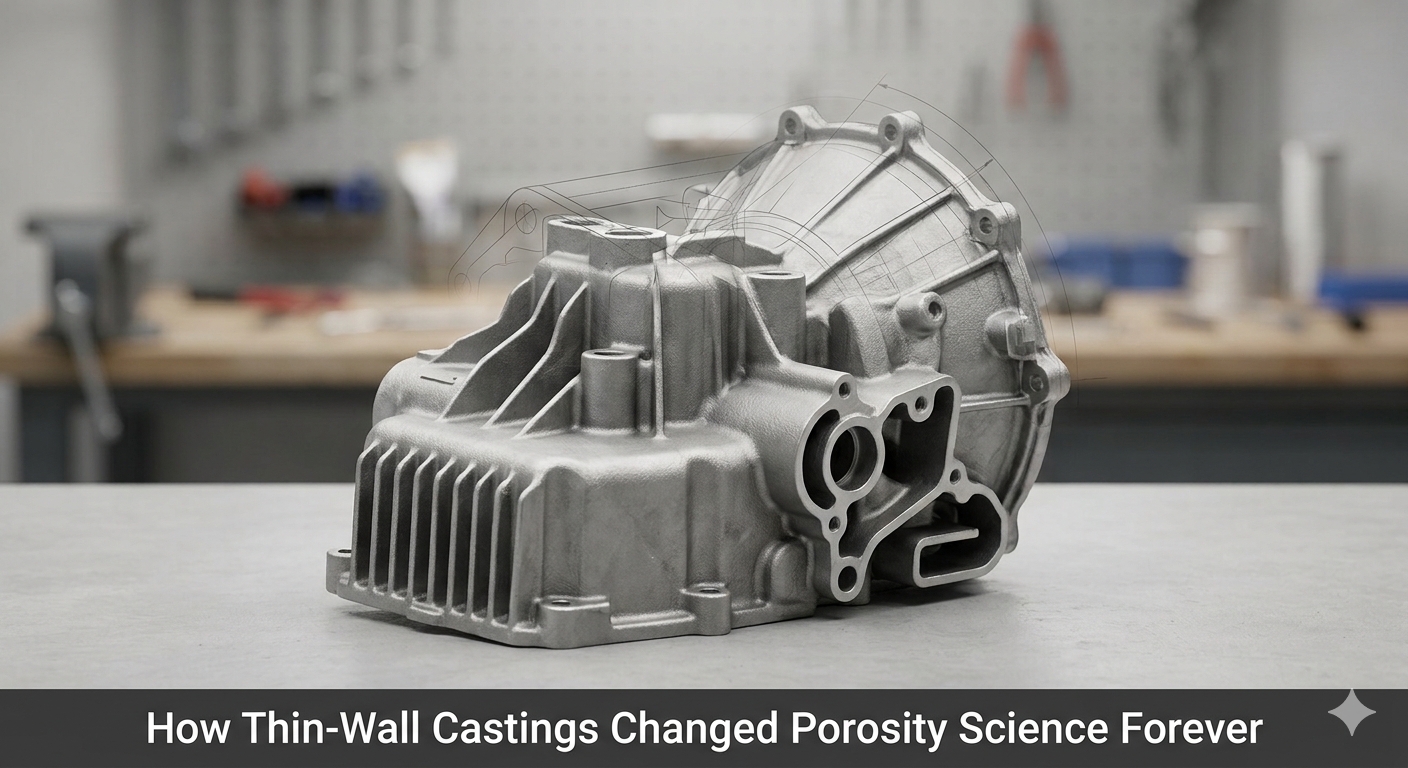
Modern lightweight engineering has permanently altered the science of porosity. As automotive, EV, aerospace and hydraulic manufacturers pursue lighter, thinner, and more compact designs, casting wall thickness has reduced dramatically — often below 3 mm in many functional zones. While this transformation improves performance, it has fundamentally increased internal porosity density and complexity.
Thin-wall castings have changed porosity from a “foundry defect” into a predictable engineering variable that must be scientifically controlled.
Why Thin-Wall Castings Are More Porous
Thinner sections cool faster. Faster cooling traps gases and prevents full metal feeding during solidification. This creates:
- Micro gas porosity
- Shrinkage micro-cavities
- Interconnected capillary networks
- Higher surface-to-core porosity density
These internal networks are invisible but form continuous leak paths.
Why Old Repair Methods No Longer Work
Welding, surface coating, and epoxy patching were adequate for thick-wall ferrous castings. In thin-wall aluminium and magnesium parts, they fail because:
- Heat distortion occurs
- Micro-capillary pores remain untreated
- Surface patches fatigue under vibration
- Dimensional stability is compromised
Thin-wall castings demand internal sealing.
How Impregnation Matches Thin-Wall Physics
Vacuum impregnation seals pores at the micro-capillary level using low-viscosity methacrylate polymers that penetrate deep into thin-wall pore networks and polymerize permanently.
This internal sealing:
- Preserves geometry
- Maintains strength
- Prevents delayed fatigue leaks
- Withstands EV thermal loads
Industry Example
An EV inverter housing supplier faced 17% rejection due to coolant leakage.
After vacuum impregnation:
| Metric | Before | After |
| Leak failures | 17% | 1.3% |
| Scrap | High | Stable |
| OEM audit | At risk | Approved |
Why Thin-Wall Castings Require Mandatory Impregnation
OEMs now require impregnation for:
- EV battery housings
- Motor casings
- Cooling plates
- Lightweight gearboxes
- Turbo compressor bodies
Thin-wall casting porosity is predictable — impregnation is the permanent solution.
Conclusion
Lightweight engineering has permanently changed porosity science. Internal sealing is no longer optional — it is mandatory.