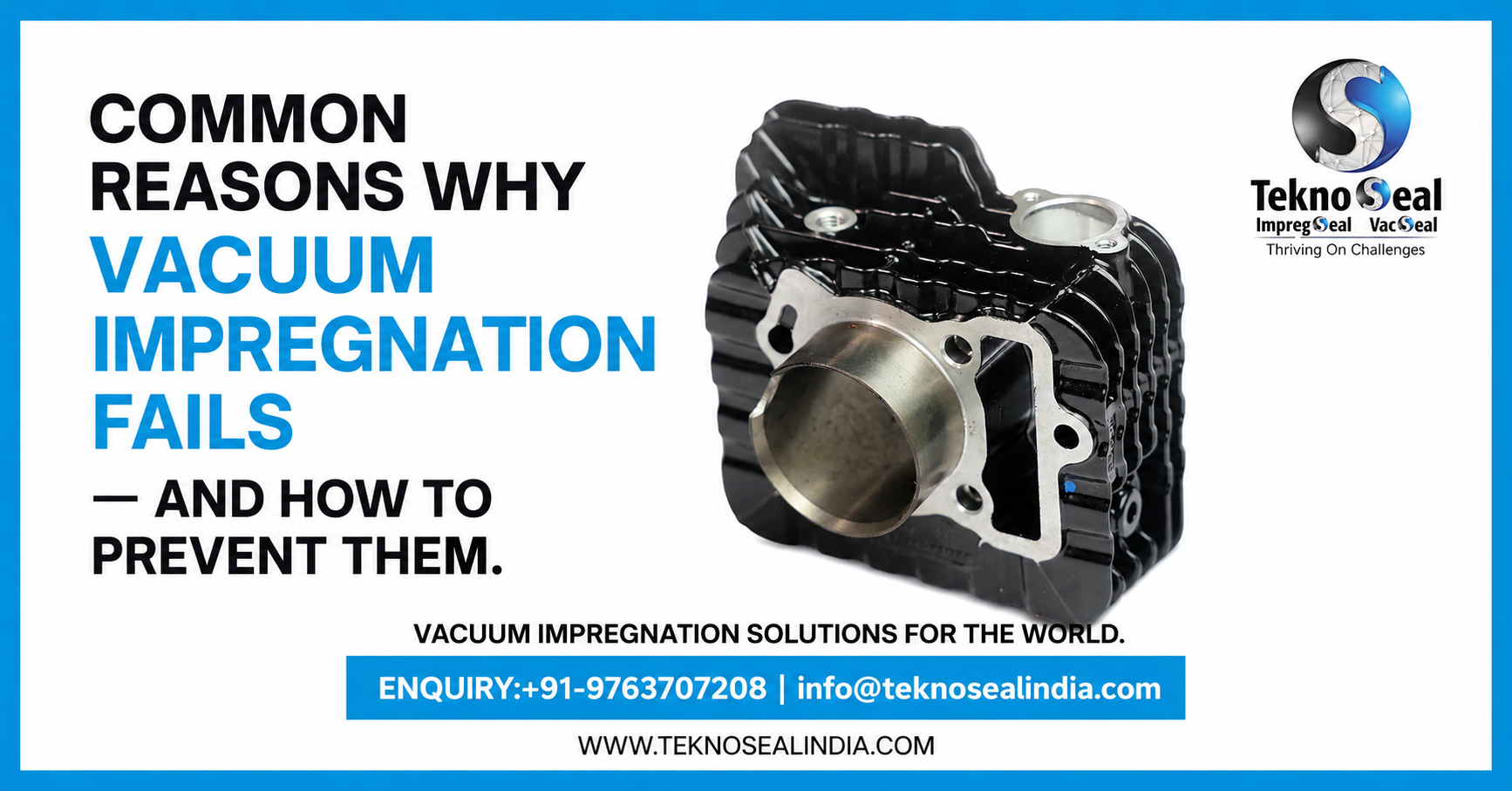
Understanding where impregnation fails — and how to prevent those failures — is essential for eliminating scrap, reducing rework loops, and protecting OEM confidence.
Why Impregnation Fails in Real Production Environments
Impregnation is a precision-controlled chemical-mechanical process. Every stage — from pretreatment to curing — must work in harmony. When even one parameter drifts, the entire sealing result becomes unstable.
Vacuum removes trapped air from pores, while pressure drives sealant into micro-channels. If either is insufficient, penetration becomes partial.
Impact: Internal leak paths remain open.Here are the most common failure points observed in plant audits:
1. Poor Pretreatment and Cleaning
If porosities are contaminated with machining oils, coolants, oxides, or fine chips, sealant cannot penetrate. Blocked porosity leads to incomplete sealing and delayed leak failures.
Impact: Sealant never reaches leak channels.
2. Insufficient Vacuum or Pressure Vacuum impregnation is recognized globally as one of the most reliable technologies for permanently sealing internal porosity in metal components. When executed correctly, it delivers stable, repeatable, and long-term leak-free performance. Yet across manufacturing plants worldwide, impregnation failures still occur — not because the technology is flawed, but because process fundamentals are ignored or inconsistently applied.
3. Incorrect Curing Temperature
Curing activates polymerization. If temperature is too low, the polymer remains weak. If too high, polymer degrades prematurely.
Impact: Weak polymer structure and delayed breakdown.
4. Sealant Contamination
Contaminated sealant loses penetration and chemical stability.
Impact: Loss of sealing performance and inconsistent results.
5. Improper Basket Loading
Dense or poorly oriented loading blocks wash, vacuum, and sealant flow.
Impact: Sealant cannot reach internal geometry.
6. Skipping Degassing Cycles
Entrapped air inside sealant blocks pore penetration.
Impact: Micro-voids remain inside polymers, reopening leak paths.
When these failures combine, plants experience scattered leak-test results, rising scrap rates, and eroding customer confidence.
Real Industry Case
A pump manufacturer was struggling with constant leak-test failures and rising rejection rates. Management initially suspected sealant quality issues. However, an audit revealed that components were being stacked too densely in impregnation baskets, preventing proper washing, vacuum penetration, and curing airflow.
The basket loading orientation was redesigned, curing temperatures was optimized , and process discipline was standardized . The results were dramatic:
- Leak failures dropped from 15% to 2%
- Rework loops were eliminated
- Customer penalty threats were withdrawn
- Production stability was restored
This case illustrates that impregnation failures are often operational — not chemical.
How to Prevent Impregnation Failures
Prevention is achieved through disciplined process control:
- Use industrial high-pressure washing before impregnation
- Maintain sealant temperature between 25°C–35°C
- Perform daily degassing cycles
- Log vacuum and pressure values for every batch
- Inspect curing temperature precision regularly
- Standardize shift procedures with SOPs
These controls transform impregnation from a reactive operation into a predictable production system.
Why Discipline Equals Profitability
Every rejected component represents compounded loss — material, machining, labour, logistics, and reputation. Stable impregnation eliminates:
- Batch variability
- Rework loops
- Delivery penalties
- Warranty exposure
- OEM audit downgrades
Plants that maintain impregnation discipline consistently outperform competitors in yield, cost efficiency, and customer confidence.
Conclusion
Vacuum impregnation is not trial-and-error — it is a controlled engineering science. When process fundamentals are respected, results are consistent, reliable, and profitable.
Process control equals performance.
Performance equals customer trust.
Customer trust equals long-term success.