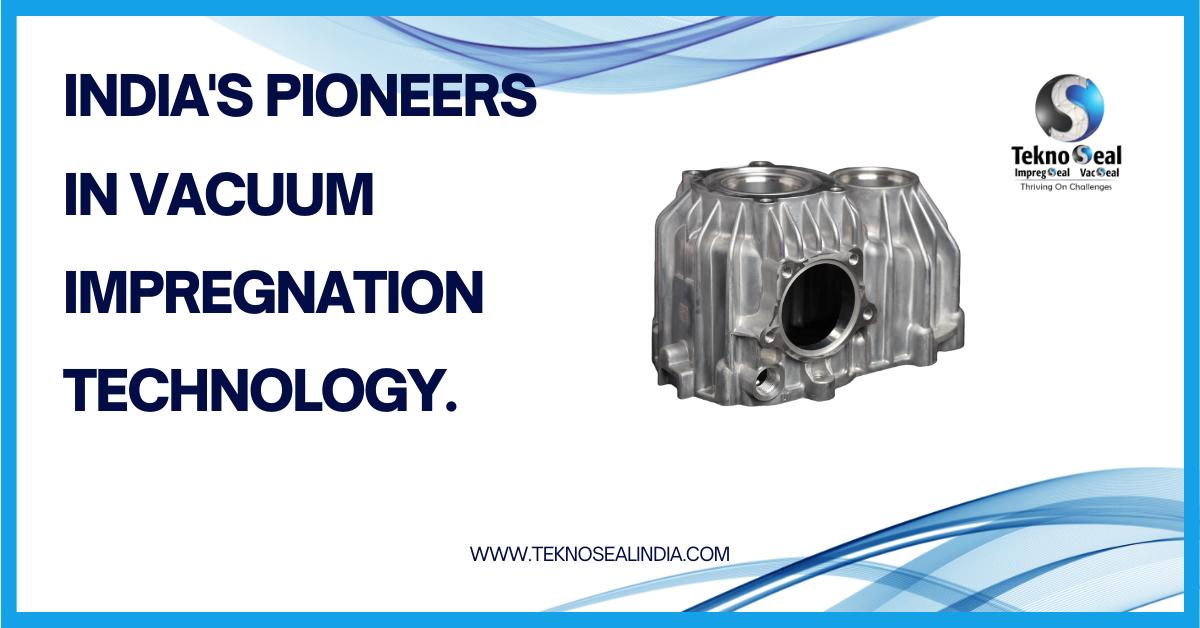
In high-precision manufacturing, quality is no longer defined only by dimensional accuracy and surface finish. Leak-proof performance, long-term reliability, and zero field failures have become critical benchmarks across automotive, electric vehicle, aerospace, hydraulics, and general engineering sectors. One of the most effective technologies enabling these outcomes is vacuum impregnation — a scientifically controlled process designed to permanently seal internal porosity in metal components.
While porosity is a natural result of metal solidification and machining, its consequences are far from natural in modern production environments. Microscopic interconnected pores create invisible leak paths that compromise pressure integrity, allow fluid seepage, and trigger expensive post-machining rejections. Vacuum impregnation eliminates these weaknesses by sealing porosity from the inside, transforming porous components into pressure-tight, production-ready parts.
For manufacturing, production, and quality engineers, understanding each stage of this process is essential to achieving consistent, repeatable, and stable leak-free results.
The Five Essential Stages of Vacuum Impregnation
1. Dry Vacuum — Removing Trapped Gases
The process begins by loading components into a sealed impregnation chamber. A deep vacuum is applied to remove trapped air, moisture, and gases from the internal pore structure of the metal. This step is critical because any air remaining inside the pores will prevent sealant penetration. Without proper degassing, impregnation becomes superficial and inconsistent.
The depth and duration of the vacuum are carefully controlled to ensure complete evacuation of internal porosity networks.
2. Wet Vacuum — Sealant Flooding Under Vacuum
Once degassing is complete, the chamber is flooded with a low-viscosity methacrylate sealant such as TSP 99 — while still under vacuum. This ensures that the sealant replaces the evacuated air inside the pores rather than trapping air pockets.
Maintaining vacuum during flooding allows the sealant to flow freely into micro-porosity networks, preparing the component for complete internal sealing.
3. Pressure Cycle — Forcing Deep Penetration
After flooding, pressure is applied inside the chamber. This step forces the sealant deeper into even the densest interconnected porosity paths. It is particularly important for thick-wall components, high-density alloys, and pressure-bearing parts where micro-channels are tightly constricted.
The pressure cycle ensures that no internal leak path remains unsealed.
4. Drain and Wash — Preserving Dimensional Accuracy
Once impregnation is complete, excess surface sealant is drained and removed using industrial washing systems. This prevents surface polymerization and ensures that the sealant remains only inside the porosity — not on functional or machined surfaces.
Proper washing is essential to preserve dimensional tolerances, surface finish, and subsequent assembly compatibility.
5. Cure / Polymerization — Permanent Internal Sealing
The final step is curing. Components are heated using hot water, steam, or controlled ovens to activate polymerization of the sealant. The liquid methacrylate transforms into a solid thermoset polymer, permanently blocking internal leak channels.
After curing, the component becomes pressure-tight, chemically resistant, and ready for assembly or further processing.
Why Process Control Determines Success
Vacuum impregnation is not a “set-and-forget” operation. It is a precision process that depends heavily on consistent control of:
- Vacuum depth and stability
- Pressure levels and dwell times
- Temperature accuracy during curing
- Sealant viscosity and contamination levels
- Cycle duration and transition timing
Any instability can lead to incomplete penetration, inconsistent sealing, rework loops, and leak-test failures.
Real Industry Case
A top manufacturer of hydraulic valve bodies for an overseas OEM was facing unpredictable leak-test failures across multiple production shifts. Investigation revealed inconsistent curing temperatures and inadequate degassing of sealant.
Teknoseal redesigned the impregnation cycle, implementing precise vacuum-to-pressure transitions, temperature stabilization, and bath condition monitoring. Within weeks:
- Rejection dropped from 11% to 1.4%
- Rework cycles were eliminated
- Annual savings exceeded several lakhs of rupees
- Delivery stability and OEM confidence were restored
Industries That Rely on Vacuum Impregnation
| Industry | Typical Components |
| Automotive & EV | Engine blocks, EV drive housings, turbo parts, compressors |
| Aerospace | Cooling systems, hydraulic components |
| Marine | Pump housings, valve bodies |
| General Engineering | Precision machined manifolds, bearings, pressure-tight components |
Conclusion
Vacuum impregnation is not merely a corrective measure — it is a strategic manufacturing tool. When integrated early, it prevents scrap, stabilizes yield, ensures consistent leak-proof performance, and strengthens OEM relationships.
For engineers committed to sustainable, high-yield, globally compliant manufacturing, vacuum impregnation is no longer optional — it is essential.