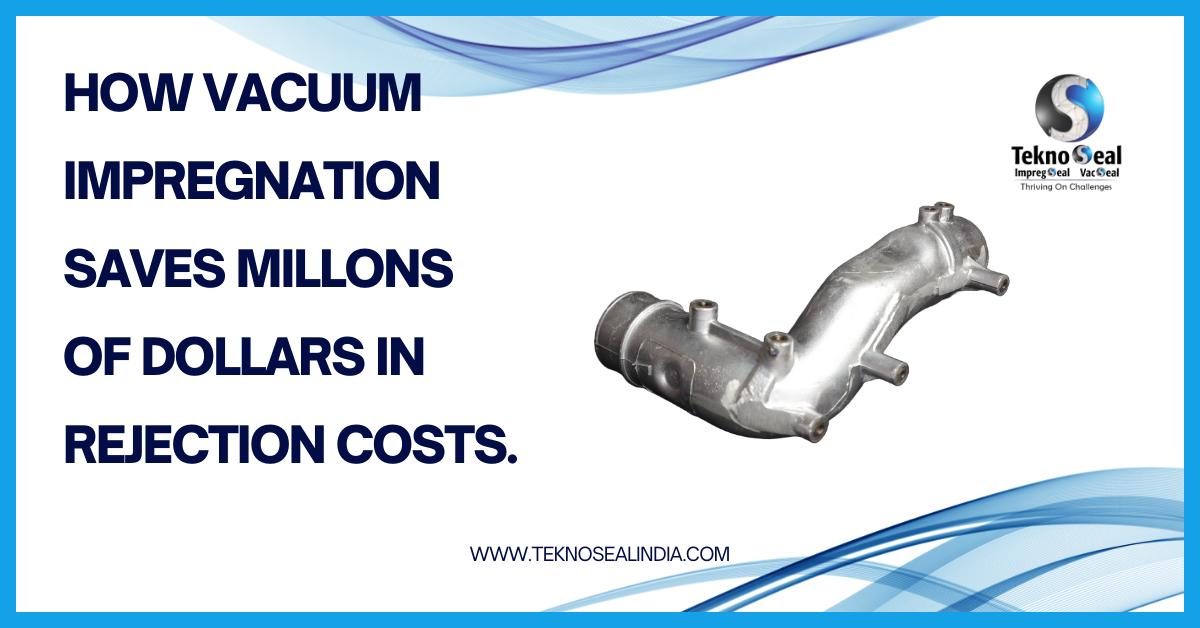
In today’s high-pressure manufacturing environment, foundry profitability is no longer defined only by output volume. It is defined by yield efficiency, rejection control, delivery reliability, and how effectively a manufacturer protects the value added at every stage of production. One of the most persistent and costly threats to these goals is porosity-related scrap.
Porosity is a natural consequence of metal solidification – especially in aluminium and magnesium alloys widely used in automotive and electric vehicle components. Microscopic voids, gas pockets, and interconnected cavities form invisibly inside castings, even when the surface appears flawless. These internal imperfections become leak paths under pressure, thermal cycling, and vibration – precisely the conditions automotive components operate in.
For decades, the industry accepted porosity-based rejection as an unavoidable cost of manufacturing. But rising raw material prices, escalating machining complexity, and increasingly strict OEM quality mandates have made this mindset financially unsustainable.
The True Cost of Scrapping Machined Components
Traditionally, when a casting fails a pressure or leak test after machining, the standard response has been to scrap the part. While this might appear as a simple quality decision, the financial implications are massive.
A scrapped machined component represents not only the loss of raw material, but also the loss of:
- CNC machining hours
- Tooling wear
- Energy consumption
- Labour cost
- Inspection and testing cost
- Delivery schedule disruptions
In other words, the deeper the manufacturing stage at which a part is rejected, the higher the compounded loss becomes. For foundries supplying automotive and EV OEMs, this can translate into lakhs – and even crores – of lost value every year.
Why Vacuum Impregnation Changes the Economics
Vacuum impregnation fundamentally changes the scrap equation by enabling foundries to permanently seal internal porosity and recover components that would otherwise be rejected.
The process works by placing cast parts in a sealed chamber where vacuum is applied to remove trapped air and moisture from the pore structure. A specially formulated low-viscosity methacrylate sealant, such as TSP99, is then introduced. Under controlled pressure, the sealant penetrates deeply into even the most complex interconnected porosity networks. Finally, heat curing polymerizes the sealant, permanently sealing all leak paths.
Unlike surface coatings, vacuum impregnation works internally. It does not alter dimensional tolerances, does not interfere with surface finishing, and does not affect subsequent machining or assembly operations. Once impregnated, the component becomes pressure-tight, chemically resistant, and fit for long-term service.
The Financial Advantage: A Simple Calculation
Consider a foundry producing aluminium automotive compressor housings:
- Value before machining: ₹1,000 per component
- Value after machining: ₹2,500 per component
- Monthly production: 5,000 components
- Porosity-related rejection: 10%
This means 500 components are scrapped every month – resulting in a direct monthly loss of ₹12.5 lakhs and an annual loss of ₹1.5 crore.
After implementing vacuum impregnation, rejection can be reduced to less than 2%. This allows the foundry to recover over ₹1 crore annually – without increasing production volume or capital expenditure. The savings directly improve margins, stabilize delivery commitments, and strengthen OEM confidence.
Real Industry Example
A Tier-1 automotive supplier manufacturing transmission valve body castings for a leading European OEM was facing severe challenges. Their rejection rate had reached 14 – 16% due to repeated leak-test failures – despite consistent casting quality and full machining completion.
These high-precision components were being scrapped after extensive CNC machining, causing significant financial loss and threatening their long-term supplier status.
Teknoseal India introduced a customized vacuum impregnation solution featuring precision degassing, optimized sealant penetration, and temperature-stabilized curing cycles. Within eight weeks:
- Rejection dropped to 1.8%
- Over ₹75 lakhs worth of components were recovered in the first quarter
- Leak-test failures were virtually eliminated
The transformation was not just financial. The OEM removed the component from revalidation risk, extended long-term contracts, and upgraded the supplier’s quality rating.
Beyond Scrap Reduction: Strategic Business Benefits
| Business Impact | Result |
| Reduced manufacturing cost | Salvages expensive machined parts |
| Improved yield | Higher margins without increasing output |
| Increased productivity | Fewer rework loops and breakdowns |
| OEM confidence | Stronger long-term supply contracts |
| Sustainability | Reduced waste and carbon footprint |
The Competitive Advantage
Across global manufacturing hubs – including Germany, Italy, USA, China, Turkey, and India – OEMs now demand zero-leak reliability as a baseline expectation. Foundries that integrate vacuum impregnation early become preferred suppliers. Those who delay face rising penalties, supplier audits, and growing cost pressure.
Vacuum impregnation is no longer a corrective expense.
It is a profit-protection technology.